

The first surviving permanent photograph appears in 1826/1827, when Joseph Nicéphore Niépce uses heliography in a camera obscura on a bitumen-coated pewter plate. The subject is “View from the Window at Le Gras”—courtyard, rooftops, a pigeon house, and a pear tree—captured over hours to several days. This work defines the invention of photography because no earlier permanent camera-made images are known. Louis Daguerre debuts the daguerreotype in 1839, cutting exposures to minutes, and William Henry Fox Talbot creates the calotype negative–positive system and publishes The Pencil of Nature.
History & timeline: camera obscura (Mozi, Aristotle, Ibn al-Haytham) → Schulze 1727 → Niépce 1826 → Niépce–Daguerre 1829 → Daguerre 1839 → Talbot 1841 → Collodion 1851 → Dry plate 1871 → Kodak 1888 → Autochrome 1907.
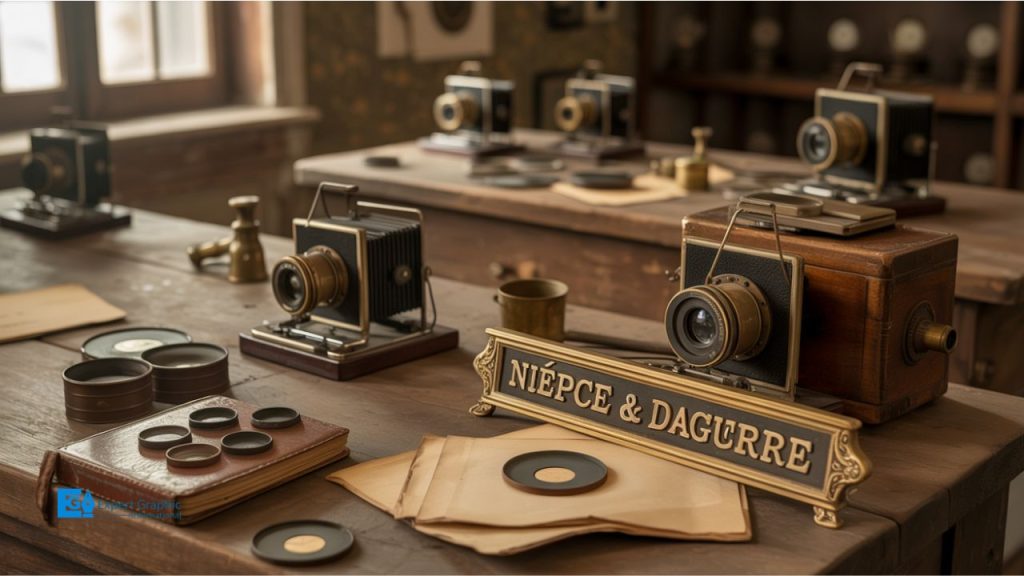
Evolution continues through Kodachrome (1935), Polaroid (1948), digital prototypes (1975), and smartphones. First machines: Niépce’s heliograph; Alphonse Giroux’s 1839 commercial daguerreotype camera. Everyday use expands with the $1 Brownie (1900/1901) because low price and roll film simplify shooting and processing. The first person visible appears in Daguerre’s 1838 street scene because the sitter and shoeshiner remained still during a long exposure. Color milestones include Maxwell/Sutton’s three-color demonstration (1861), Autochrome (1907), and Kodachrome (1935).
When was the first photograph taken?
The first photograph is taken in 1826 or 1827 by Joseph Nicéphore Niépce, titled “View from the Window at Le Gras,” at Saint-Loup-de-Varennes, Burgundy, France, using heliography with a camera obscura on a pewter plate coated with bitumen of Judea.
The first photograph is taken, and the date range 1826 or 1827 reflects surviving records. The scene is viewed from an upstairs window at Niépce’s estate, and the plate is the oldest surviving and first permanent photograph because no earlier permanent camera-made images are known.
The process used is heliography. He projects the view with a camera obscura onto a 16.2 cm × 20.2 cm polished pewter plate. The bitumen of Judea hardens in strong light. He then washes the rest with oil of lavender and white petroleum to reveal a permanent image.
The image content is as follows. The blurry, indistinct photo captures rooftops, a courtyard, and surrounding trees. Light visible on two sides of the buildings suggests an exceptionally long exposure time, estimated as about eight hours to several days.
Consider the work’s significance. The photograph marks the beginning of photography as we know it because it is the earliest surviving permanent camera photograph. The original pewter plate is in the permanent collection of the Harry Ransom Center at the University of Texas at Austin.
Place the work within its early historical context. Niépce invents heliography around 1822, visits the United Kingdom in late 1826, shows specimens to Francis Bauer, and faces a Royal Society rule against undisclosed secret processes. After 1839 announcements by Daguerre and Talbot, Bauer helped exhibit the specimens on March 9, 1839. The plate then fell into obscurity after 1905 for nearly fifty years.
Who took the first photograph ever?
Joseph Nicéphore Niépce, French inventor, took the first permanent photograph “View from the Window at Le Gras” in 1826 or 1827, from an upstairs window in Burgundy, using heliography with a camera obscura on a pewter plate coated with bitumen of Judea.
What was the subject of the first photo ever made?
The subject of the first photo ever made was the view from an upstairs window of Joseph Nicéphore Niépce’s estate, Le Gras, in Saint-Loup-de-Varennes, Burgundy, France showing a courtyard, rooftops, outbuildings, a pigeon-house, a pear tree, and surrounding countryside.
The subject appears in the image titled “View from the Window at Le Gras.” The view is framed by a high window overlooking Niépce’s estate. The upstairs vantage centers everyday buildings and landscape elements, such as rooftops and outbuildings.
The scene includes specific details: a courtyard between structures, rooftops angling into the frame, outbuildings flanking the yard, a pigeon-house near a pear tree, and countryside stretching beyond the immediate roofs and walls.
The subject’s appearance follows from the process. Niépce uses heliography with a camera obscura on a bitumen-coated pewter plate. A very long exposure, lasting many hours, allows sunlight to hit two sides of the buildings, making them appear softly lit on both faces.
The subject is in France at Le Gras, Niépce’s home in Burgundy. The exposure dates to 1826 or 1827, when the scene was captured from the upstairs window. As a clear, ordinary view made momentous, it anchors the world’s earliest surviving permanent camera photograph because no earlier permanent examples are known.
How long did the first photograph take to expose?
The first photograph’s exposure takes at least eight hours commonly approximately eight hours or several hours, sometimes as long as a day; modern researchers estimate several days for Joseph Nicéphore Niépce’s “View from the Window at Le Gras,” using heliography on bitumen-coated pewter.
Who invented photography?
Joseph Nicéphore Niépce is credited with inventing photography creating the first permanent photograph in 1826 via heliography though the invention is often attributed to several individuals, notably Louis Daguerre (daguerreotype, 1839) and William Henry Fox Talbot (calotype negative–positive process, 1839).
Niépce invents photography by fixing a camera image permanently, stabilizing a camera-projected view on a photosensitive plate. He uses heliography: a bitumen-coated pewter plate inside a camera obscura, exposed for several hours. He demonstrates permanence in 1826 with View from the Window at Le Gras because the image survives solvent washing and remains stable.
Niépce’s route includes earlier trials. From 1822 he copies oiled engravings onto stone, glass, zinc, and later pewter. Letters from 1816 describe silver-chloride paper negatives that darken when viewed because they are not fixed. In 1825 he produces photo-etchings from photographically made plates, showing that photographic images can be transferred onto printable metal matrices.
When did Joseph Nicéphore Niépce invent photography?
Joseph Nicéphore Niépce invents photography in 1826 or 1827 by creating the first permanent photograph, “View from the Window at Le Gras,” at Saint-Loup-de-Varennes, France, using heliography with a camera obscura on a pewter plate coated with bitumen of Judea.
The date range matters. Sources place the invention in 1826 or 1827, tied to the surviving plate of “View from the Window at Le Gras.” You can cite either year when you discuss the invention in class notes or timelines.
What was Louis Daguerre’s role in the invention of photography?
Louis Daguerre’s role is to develop the daguerreotype the first practical, commercially successful photographic process after partnering with Nicéphore Niépce (1829); announced by the French government on August 19, 1839; it reduces exposure times and yields unique, detailed images on silver-plated copper.
Daguerre partners with Nicéphore Niépce in 1829. After Niépce’s death in 1833, he refines their experiments and pursues a practical method that captures permanent images. His role is to turn a laboratory curiosity into a usable system because he standardized materials and procedures that produced repeatable results.
Daguerre’s daguerreotype process uses a polished, silver-plated copper sheet sensitized with iodine, exposed in a camera, developed with heated mercury vapor, and fixed with common salt (with sodium thiosulfate adopted later). The plate yields a unique, mirror-like image with striking detail.
Daguerre reduces exposure time from many hours to about 20–30 minutes, and later improvements bring it to a minute or less. This speed made portrait sittings and street scenes feasible, a real-world change evidenced by early studios and images such as Boulevard du Temple (1838).
On August 19, 1839, the French government announces the daguerreotype to the world as a gift, purchasing the rights and granting lifetime pensions to Daguerre and Niépce’s son. A prior August 2, 1839 demonstration sets the stage for broad adoption.
These outcomes define the process’s impact and legacy because adoption was rapid and global. The daguerreotype becomes the first widely adopted photographic method, dominant through the 1840s and early 1850s. Studios open across the world, including in Paris, London, and New York. The limitation is inherent: each plate is a single, non-reproducible image, a constraint later overcome by negative–positive methods such as the calotype and, soon after, wet-collodion glass negatives with albumen prints.
Daguerre’s background matters because his work as a French artist, theatrical scene painter, and creator of the Diorama trained him to control lighting, perspective, and spectacle. Those skills informed his chemistry and optics, helping establish him as a founding figure in photography.
How did William Henry Fox Talbot contribute to photography’s evolution?
William Henry Fox Talbot contributed to photography’s evolution by inventing the negative/positive calotype, introducing development to reveal latent images, enabling multiple paper prints, cutting exposure from hours to minutes, and publishing The Pencil of Nature to demonstrate broad scientific uses.
Talbot invents the negative/positive process. The calotype creates a paper negative that produces many positives. This reproducibility moves photography beyond the one-off daguerreotype and enables mass distribution and everyday access.
Talbot refines early techniques. He starts with photogenic drawing on light-sensitive paper to record botanical silhouettes under the sun. He then advances to salted paper and the calotype, both relying on paper substrates and manageable chemistry.
Talbot reduces exposure times. He introduces a developer stage that reveals a latent image after a brief exposure. This shift from printing-out to developing-out shortens the wait from hours to minutes and makes camera work practical for portraits, architecture, and landscapes.
Talbot secures permanence. With John Herschel’s suggestion of sodium thiosulfate (hypo), he fixes images by washing away unreacted chemicals. The prints no longer darken in light, which preserves legibility during handling and display.
Talbot shapes terminology and pedagogy. He popularizes “negative” and “developing.” He publishes The Pencil of Nature (1844–1846), the first commercially published book illustrated with original photographs, presenting architecture, still lifes, and botanical examples as practical use cases.
Talbot drives science and art. He pioneers the first photomicrograph and expands subjects to portraits and architecture. Photography emerges as both a research tool and an expressive medium because shorter exposures and reproducible negatives widen the creative menu.
Talbot advances photomechanical printing. In the 1850s he develops photoglyphic engraving to etch photographs onto metal plates for ink-based printing, a precursor to photogravure. This development points toward modern publishing workflows where images and text travel together.
What is the history of photography?
The history of photography begins with the camera obscura, advances through Niépce’s 1826 heliography, Daguerre’s 1839 daguerreotype, Talbot’s calotype, dry plates and Eastman’s Kodak roll film, then transforms with color, instant cameras, Sasson’s 1975 digital camera, and smartphone photography.
Photography’s origins rest on the camera obscura: a dark room or box with a pinhole that projects an image. Chinese and Greek thinkers, including Mozi and Aristotle, describe the principle. Giambattista della Porta adds lenses and diaphragms, and Leonardo da Vinci sketches the optics.
Permanent images start with Joseph Nicéphore Niépce. In 1826/1827 he makes “View from the Window at Le Gras” by heliography on pewter coated with bitumen of Judea. The exposure runs from about eight hours to several days, which lights both sides of buildings.
Louis-Jacques-Mandé Daguerre develops the daguerreotype in 1839. He polishes a silver-plated copper plate, sensitizes it with iodine vapor, develops with mercury fumes, and fixes with salt. The result is a unique, highly detailed image, publicly announced by the French government on August 19, 1839.
William Henry Fox Talbot advances a different track. In 1840–1841 he patents the calotype, a negative/positive process using paper negatives and developing to reveal a latent image. Multiple positive prints become possible, and exposure drops from hours to minutes.
Mid-century chemistry speeds production. Frederick Scott Archer’s wet-plate collodion (1851) blends daguerreotype sharpness with calotype reproducibility. Ambrotypes on glass and tintypes on iron spread widely. André-Adolphe-Eugène Disdéri popularizes carte-de-visite albumen prints in 1854.
Dry plates and roll film make photography portable. Richard Maddox introduces the gelatin dry plate in 1871. George Eastman launches Kodak roll film and the 1888 Kodak camera—“You press the button, we do the rest”—opening mass-market picture taking.
Smaller formats boost mobility. In 1925 Leica standardizes the compact 35mm camera. Lightweight gear and faster shutters enable candid photography.
Color photography broadens expression. James Clerk Maxwell demonstrates three-color separation in 1861. The Lumière Autochrome (1907) uses dyed potato starch screens. Kodak’s Kodachrome (1935) delivers modern color transparency film with multilayer emulsions.
Instant photography shortens the wait. In 1947 Edwin Land’s Polaroid Land Camera Model 95 produces finished prints in about 60 seconds. Families and scientists see results on the spot without a darkroom.
Digital imaging rewrites the workflow. The CCD sensor appears in 1969. Steven Sasson at Kodak builds the first digital camera in 1975 (about eight pounds, 0.01-megapixel, cassette storage). Consumer models arrive in the 1990s, including the Apple QuickTake 100 (1994).
The rise of digital accelerates in the 2000s. Affordable cameras and smartphone integration make photography ubiquitous because most phones include networked cameras for instant capture, review, and sharing, while the lineage still traces back to the camera obscura and silver chemistry.
What was the timeline of photography’s invention?
Timeline spans camera obscura (Mozi, Aristotle) → Ibn al-Haytham; Schulze 1727 silver nitrate; Niépce 1826 heliography; Niépce–Daguerre 1829; Daguerre 1839 daguerreotype; Talbot 1841 calotype; Archer 1851 collodion; Maddox 1871 dry plate; Eastman 1888 Kodak; Autochrome 1907.
Ancient optics set the stage. The camera obscura is described by Chinese and Greek philosophers, including Mozi and Aristotle. Ibn al-Haytham analyzes pinhole projection and explains how inverted images form inside a dark chamber.
Early chemistry provides the trigger. In 1727 Johann Heinrich Schulze shows that silver nitrate darkens by light, not heat. He records words with sunlight but cannot fix the images. These experiments point toward durable photographs.
The first permanent photograph arrives. In 1826 Joseph Nicéphore Niépce uses heliography with a camera obscura and a bitumen-coated pewter plate to capture “View from the Window at Le Gras.” The exposure runs at least eight hours, possibly several days.
Collaboration accelerates progress. In 1829 Niépce partners with Louis-Jacques-Mandé Daguerre to refine heliography. After Niépce’s death in 1833, Daguerre continues experiments focused on shortening exposure and stabilizing the image.
A practical process is announced. In 1839 Daguerre introduces the daguerreotype—an iodine-sensitized, silver-plated copper plate developed with mercury vapor and fixed with salt. Exposures drop to minutes, and the French government releases the method to the world.
Reproducibility transforms output. In 1841 William Henry Fox Talbot patents the calotype, a negative–positive paper process. Multiple positives can be printed from one paper negative, shifting photography from one-off plates to scalable production.
Mid-century chemistry speeds capture. In 1851 Frederick Scott Archer creates the wet-plate collodion process. Photographers gain daguerreotype-like sharpness with calotype-style reproducibility. Ambrotypes on glass and tintypes on iron broaden affordable portrait work because materials are inexpensive and processing is quick.
Dry plates simplify the workflow. In 1871 Richard Leach Maddox introduces the gelatin dry plate. Photographers no longer need a portable darkroom. Sensitivity improves, and exposure times fall further, enabling reliable work across more subjects.
Roll film popularizes snapshots. In 1888 George Eastman launches the Kodak roll-film camera—“You press the button, we do the rest.” By 1900 the one-dollar Brownie spreads mass-market photography and fills family albums because the camera is cheap and easy to use.
Color enters everyday practice. In 1907 the Lumière brothers release Autochrome, the first commercially successful color plate. Later color films, such as Kodachrome (1935) and Ektachrome (1940s), expand creative range, but Autochrome marks a key early milestone in this timeline.
How did photography evolve after its invention?
Photography evolves after its invention through gelatin dry plates (1871), roll film and Kodak (1888), Kodachrome color (1935), Polaroid instant (1948), automation—Agfa auto exposure (1956) and Canon autofocus (1963), the digital revolution (digital camera 1976; 1990s commercial), and smartphone ubiquity.
Early evolution improves processes and portability. Gelatin dry plates (1871) replace the cumbersome wet plate. Photographers no longer need a portable darkroom. Roll film (1888) and the Kodak camera make everyday shooting straightforward and popular because loading is simple and processing is centralized.
Accessibility grows fast. Late-19th-century formats such as the carte-de-visite spread portrait collecting. User-friendly cameras lower barriers, and families, travelers, and students document daily life with ease because costs fall and operation becomes simpler.
Color and instant features change expectations. Kodachrome (1935) brings reliable color for slides and home use. Polaroid (1948) delivers instant photography in minutes, allowing on-the-spot previews without lab processing.
Automation simplifies exposure and focus. Agfa’s auto exposure (1956) meters light automatically. Canon’s autofocus prototype (1963) reduces guesswork and speeds capture. These steps yield sharper photos in tricky light because exposure and focus errors decrease.
Digital technology reshapes the workflow. A 1976 digital-camera prototype demonstrates electronic capture. 1990s commercial models remove film and chemicals, add instant preview, and simplify editing. New materials and sensors drive exposures from minutes to seconds to fractions.
Cameras everywhere redefine behavior. Smartphones integrate capable sensors and lenses, and networked sharing enables instant distribution at scale. Today AI, computational photography, and software tuning improve image quality and expand creative options.
What photographic machine was first invented?
The first photographic machine was Joseph Nicéphore Niépce’s heliograph (1826/1827): a camera obscura exposing a pewter plate coated with bitumen of Judea, making “View from the Window at Le Gras”; first manufactured camera: Alphonse Giroux’s daguerreotype (1839, Daguerre’s process).
Niépce’s heliograph defines “first.” It is the earliest camera process to capture an image permanently. The method uses a camera obscura and a pewter plate coated with bitumen of Judea dissolved in lavender oil. Exposures run for many hours—sometimes days—until light hardens the coating.
How the heliograph works: bright light hardens the bitumen where it strikes; after exposure, solvent removes the unhardened areas, leaving a fixed image. This workflow yields the earliest surviving photograph, the Le Gras window view, because no earlier permanent camera-made examples are known.
The first commercially produced camera appears in 1839. Alphonse Giroux manufactures the daguerreotype camera based on Louis Daguerre’s process. It uses a silver-plated copper sheet, iodine sensitizing, mercury-vapor development, and saltwater fixing to produce sharp, one-of-a-kind positives.
Giroux’s camera matters because it expands access. The daguerreotype becomes widely popular in the 1840s and 1850s as portrait studios boom; sitters endure only minutes of exposure and receive detailed, mirror-like images, even though each plate remains non-reproducible.
The camera obscura sits earlier in the chain. It is a dark chamber or box that projects an inverted image through a small hole or lens. Artists can trace the projection, but it does not record permanently because it lacks a light-sensitive surface.
The transition toward modern devices accelerates with George Eastman’s Kodak (1888), a roll-film, box camera for the mass market. “You press the button, we do the rest” becomes a practical workflow: the user trips the shutter, the company processes and returns prints, and photography moves from the lab bench to everyday life.
Who invented the first camera?
Joseph Nicéphore Niépce invented the first photographic camera in 1816, using heliography, a camera obscura, and Bitumen of Judea on a pewter plate; he produced the first permanent photograph in 1826–1827. Louis Daguerre and Alphonse Giroux (1839) later commercialized it.
Niépce defined the first permanent camera process by pairing a camera obscura with heliography. He coats a pewter plate with bitumen of Judea, exposes it for many hours, and then fixes the image. “View from the Window at Le Gras” (1826/1827) demonstrates permanence because it survives solvent development as the earliest surviving camera-made photograph.
What defined early photography?
Early photography is defined by long exposures, chemical processes on pewter plates and silver-plated copper sheets, permanence and resolution limits, camera obscura roots, Niépce’s heliography, Daguerre’s daguerreotype, Talbot’s calotype, wet-plate collodion glass negatives, tintypes, monochrome images, and fixing with hypo.
When did photography become common?
Photography becomes common in the early 1900s, when Kodak’s $1 Brownie an easy-to-use roll-film box camera opens mass access; mass-market beginnings appear with Kodak No. 1 (1888); ubiquity follows with consumer digital cameras (1990s–mid-2000s) and camera phones (2000s–present).
Photography spread as access expanded in the 19th century. Commercial studios opened in the 1840s (e.g., Nadar in Paris; Southworth & Hawes in Boston). The carte-de-visite circulated widely in the late 19th century through Disdéri’s format. Dry plate technology in the 1870s–early 1880s enabled amateurs because pre-coated plates eliminated the portable darkroom and shortened exposures.
The Brownie catalyzed mass adoption. In 1900–1901 Kodak priced the Brownie at about one dollar and paired a simple cardboard-box design with roll film, making everyday snapshots feasible and affordable. Families compiled albums, and “snapshooters” multiplied across generations because film processing was turnkey.
Mid-century convenience sustained growth. The Polaroid Land Camera (1948) delivered a finished print in about 60 seconds at parties and events, and the Instamatic (1963) simplified point-and-shoot use with 126 cartridges as color film became affordable for amateurs, displacing much black-and-white.
By the 1980s photography was routine in home life. Compact 35 mm cameras (e.g., Olympus XA, Canon Sure Shot) dominated family photos. People shot 12, 24, or 36-exposure rolls and sent film to labs; processing took days or weeks, so blinking or mis-exposure often surfaced only after development.
Digital systems made photography ubiquitous. Consumer digital cameras in the 1990s–early 2000s (e.g., Apple QuickTake 100, Sony Cyber-shot, Canon PowerShot) provided instant review and removed film and chemicals, replacing film for most consumers by the mid-2000s. Camera phones from the 2000s onward (e.g., Sharp J-SH04, iPhone) made capture and sharing everyday behavior because images could be created, viewed, and distributed on a single device.
What was the first photograph of a person?
The first photograph of a person was Louis Daguerre’s 1838 daguerreotype, Boulevard du Temple, Paris, showing a man getting his shoes shined with the shoeshiner, captured from a window during a long exposure (about 4–7 minutes), rendering the street empty.
The photo shows a Paris street scene from a window on the Boulevard du Temple. Motion blurs most traffic and pedestrians. With an exposure lasting several minutes, only still elements register clearly on the plate.
The subjects appear because they stay still. A man getting his shoes shined and the shoeshiner hold their positions long enough to be recorded. Their steadiness turns them into the first people visible in a photograph.
The process is a daguerreotype with a long exposure. Contemporary accounts estimate about four to seven minutes. This duration explains why moving carriages and passersby disappear from the scene.
The capture occurs in Paris, near Daguerre’s studio at the Diorama de Louis Daguerre. Accounts place it around 8:00 a.m. between April 24 and May 4, 1837 or 1838, on a plate about 13 × 16 cm.
The composition reads as a nearly empty street with a human pair at the lower left. A crop showing people highlights the bootblack and his customer. The scene demonstrates early limitations and a new way to record daily life because long exposures erase motion and demand rigid poses.
Niépce’s View from the Window at Le Gras predates this with an eight-hour exposure and only static objects. Robert Cornelius creates an early portrait in 1839, marking rapid progress in human representation.
When were color photographs invented?
Color photographs were invented in the mid-19th century: Thomas Sutton’s 1861 full-color photo, based on James Clerk Maxwell’s 1855 three-color theory; practical invention arrives with Lumière Autochrome (1907); modern integral tripack color film Kodachrome (1935) drives dominance by the 1970s.
Color photographs are invented on a scientific foundation. James Clerk Maxwell proposed the three-color theory in 1855. He shows that combining red, green, and blue light reproduces all colors. This insight primes practical methods and guides every later color process.