
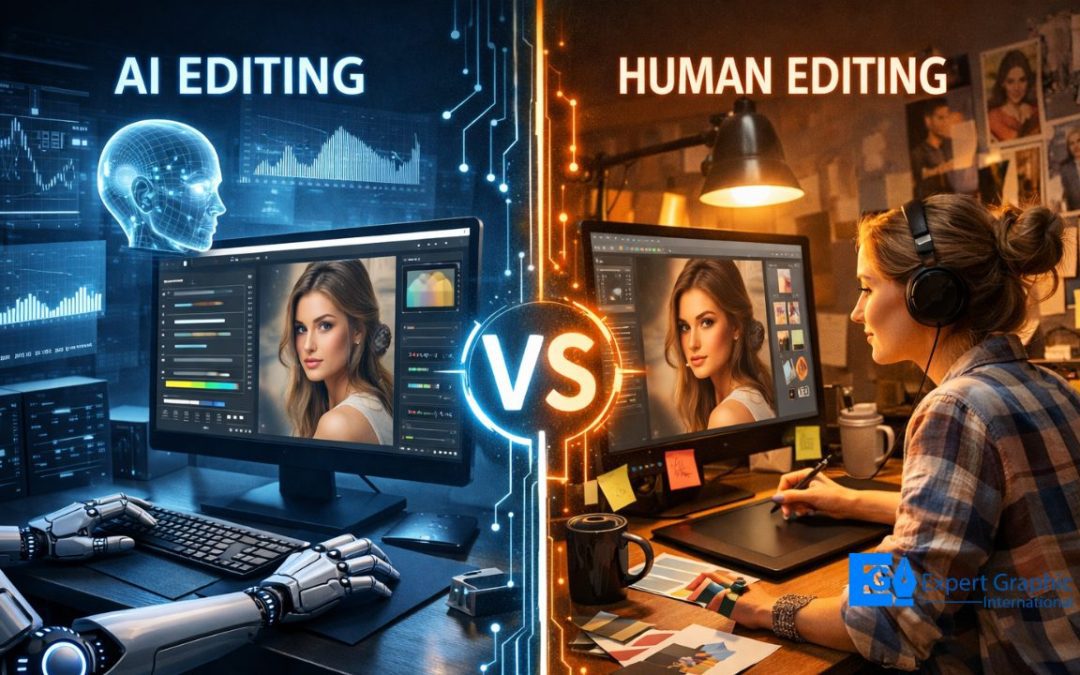
AI photo editors use machine learning to handle tasks like background removal, color correction, and object erasure in seconds. Human editors bring artistic judgment, cultural context, and brand-specific creativity that no algorithm can replicate. AI tools cost $0.05–$0.10 per image, while human editors run $0.15–$0.30. For bulk e-commerce or real estate jobs, AI wins on speed and price. For weddings, fashion campaigns, or complex restorations, humans deliver the nuance that matters. The hybrid model splits the difference: AI handles the grunt work, humans apply the finishing touches. Pick your tool based on what your project actually needs.
Understanding AI in Photo Editing
AI in photo editing is a computational technology that utilizes machine learning and neural networks to automate image analysis, enhancement, and manipulation. This technology replaces traditional manual adjustments with algorithmic processing. Neural networks analyze image content through vast datasets. AI software executes rapid, high-quality edits including background removal and object erasure. Cloud-based processing facilitates complex image computations. AI systems apply specific creative enhancements, if the algorithm identifies distinct elements like human faces or landscapes. Beginners access professional results through intuitive interfaces. The functional capabilities of AI in photo editing are outlined below.
- Automated lighting optimization.
- Intelligent object erasure.
- Precise background removal.
- Algorithmic color correction.
- Personalized style adaptation.
What Can AI Photo Editors Actually Do? (Key Features & Limitations)
An AI photo editor is a software tool that executes automated image enhancement, subject manipulation, and pattern recognition using machine learning algorithms. Neural networks recognize visual patterns in faces, objects, lighting, and textures. These tools perform complex edits with minimal user input. AI photo editors increase efficiency for bulk editing tasks. The software produces professional visuals, if the user requires rapid output.
The features of AI photo editors are outlined below.
- Background removal
- Color correction
- Object removal
- Subject masking
- Scene generation
- Image stylization
The limitations of AI photo editors are outlined below.
- Creative control restrictions
- Complex compositing difficulties
- Artistic nuance deficits
What Can Human Photo Editors Actually Do? (Skills & Limitations)
A human photo editor is a professional who selects, positions, and modifies photographic images to meet specific publication guidelines and aesthetic standards. This creative professional manages visual assets for outlets including magazines, books, and newspapers. The skills and functions of human photo editors are outlined below.
- Knowledge of advanced photography, imagery, and design.
- Detection of visual nuances including shadows and skin blemishes.
- Interpretation of cultural context for audience resonance.
- Collaboration with clients for preference alignment.
- Execution of complex manipulations and color grading.
- Maintenance of brand-specific aesthetic consistency.
Human editors provide creative judgment and artistic vision. Automated AI tools manage speed, bulk editing, and basic enhancements. Human intervention rectifies visual errors, if automated software fails to recognize technical nuances.
AI vs Human Photo Editors: Which One is Faster?
AI photo editors are faster than human photo editors. AI photo editors are computational tools that process image data in seconds. Human editors require minutes or hours for identical tasks. Mathematical algorithms execute lighting adjustments, background removals, color corrections, and skin retouching. Automation completes large-scale projects, such as e-commerce catalogs, in minutes. Human editors provide creative nuance, whereas AI systems provide superior speed. The benefits of AI photo editors for processing speed are outlined below.
- Rapid completion of massive image datasets.
- Immediate execution of repetitive editing tasks.
- Substantial reduction in total production time.
AI vs Human Photo Editors: Which One is More Cost-Effective?
AI photo editors are more cost-effective for high-volume, standardized tasks, whereas human editors are more cost-effective for complex, creative projects. Digital image editing is a post-production service categorized by automation and manual labor. AI software charges $0.05 to $0.10 per image. Professional human editors charge $0.15 to $0.30 per image. The comparative benefits of AI and human editing are outlined below.
- AI automation ensures high-scale consistency for e-commerce and color correction.
- Human expertise ensures artistic excellence for complex storytelling.
- Volume discounts reduce the cost per image, if the user selects annual plans.
AI vs Human Photo Editors: Which One Delivers Better Consistency and Quality?
AI photo editors deliver better technical consistency, whereas human editors deliver superior quality and creative nuance. AI photo editors are software applications that maintain technical uniformity across thousands of images. These tools optimize e-commerce product catalogs, real estate listings, and inventory photography. Human photo editors are creative professionals who produce refined, polished, and brand-aligned results. Human consistency varies, if multiple editors manage a single project. Human editors prioritize artistic precision and storytelling. The advantages of AI and human editors are outlined below.
- Technical uniformity
- Processing speed
- Creative nuance
- Artistic precision
AI vs Human Photo Editors: Which One is More Accurate and Detail-Oriented?
Human photo editors are more accurate and detail-oriented than artificial intelligence systems. Photo editing is a digital image modification process. Human editors identify shadows, blemishes, and subtle imperfections. Professional editors recognize artistic nuance, context, and emotional tone. AI software prioritizes speed and consistency for high-volume tasks. AI systems generate unnatural artifacts if the image requires high-end precision. The attributes of human photo editors are outlined below.
- Recognition of natural skin tones.
- Adjustment of complex background lighting.
- Delivery of tailored image quality.
- Comprehension of creative intent.
AI vs Human Photo Editors: Which One Offers More Creativity and Customization?
Human photo editors offer more creativity and customization than artificial intelligence. A human photo editor is a creative professional who utilizes artistic intuition and storytelling requirements to produce visual media. Human editors possess a nuanced understanding of brand voice and artistic trends. Artificial intelligence tools prioritize speed and consistency for bulk editing tasks. Human professionals achieve emotional resonance and contextual depth in high-end projects. The benefits of human photo editors are outlined below.
- Artistic intuition
- Brand-specific adaptation
- Emotional resonance
- Contextual storytelling
AI vs Human Photo Editors: Which One Fits Your Brand and Use Case?
AI and human photo editors are complementary resources whose selection depends on the specific requirements of volume, speed, and creative depth. AI photo editors provide automation, cost-efficiency, and large-scale consistency. Human photo editors offer creative nuance, emotional resonance, and brand-specific storytelling. AI executes routine tasks such as background removal and resizing. Human editors manage high-end fashion campaigns, weddings, and complex photo restorations. Deploy AI tools, if the project involves high-volume e-commerce or real estate batch edits. Employ human editors, if the use case requires authenticity and artistic customization. The hybrid editing model is a workflow that integrates AI automation with human oversight to maximize productivity. The benefits of the hybrid model are outlined below.
- Productivity through automated initial repetitive edits.
- Precision through human-led finishing touches.
- Authenticity through manual attention to detail.
When to Choose AI, Human Photo Editors, or a Hybrid Approach?
The decision to choose AI, human photo editors, or a hybrid approach depends on three key factors: speed, cost-efficiency, and creative quality. AI photo editing is an automated processing method that optimizes bulk consistency for large-scale catalogs. Human photo editing is a manual refinement service that provides artistic judgment for high-stakes visuals. The hybrid approach is an integrated workflow that combines repetitive correction automation with professional refinement. The selection criteria for photo editing methods are outlined below.
- AI Selection: Prioritize speed and bulk consistency for routine edits.
- Human Selection: Prioritize creative precision and brand alignment for premium content.
- Hybrid Selection: Prioritize the balance of operational efficiency and professional-grade quality.
AI processing suits the project, if requirements include rapid completion of routine tasks. Human editing suits the project, if requirements include creative storytelling and brand identity. The hybrid model suits the project, if requirements include both high-volume efficiency and professional-grade finishing touches.
Is AI photo editing software replacing human photo editors in professional workflows?
AI photo editing software does not replace human photo editors in professional workflows. AI tools automate repetitive tasks including background removal, color correction, and object erasure. Human editors perform complex manipulations, brand-specific color grading, and culturally contextual storytelling. The hybrid model integrates both resources: AI handles initial bulk processing, and human editors apply finishing touches. Professional workflows in fashion, wedding, and restoration photography retain human editors as the primary decision-makers.
What is the average cost difference between AI and human photo editing per image?
AI photo editing costs $0.05 to $0.10 per image. Human photo editing costs $0.15 to $0.30 per image. The cost difference is $0.10 to $0.20 per image in favor of AI automation. AI editing delivers cost efficiency for high-volume e-commerce catalogs and real estate inventory. Human editing delivers cost efficiency for complex creative projects requiring artistic judgment, brand alignment, and emotional resonance.
What is a hybrid photo editing model and how does it work?
A hybrid photo editing model is a workflow that combines AI automation with human oversight to maximize both productivity and output quality. AI software executes initial repetitive edits including background removal, resizing, and basic color correction. Human editors then apply finishing touches, correct technical errors the AI fails to recognize, and ensure brand-specific aesthetic consistency. The hybrid model suits projects requiring both high-volume efficiency and professional-grade precision.
What specific tasks does AI photo editing software fail to perform accurately?
AI photo editing software fails to perform 3 specific tasks accurately: complex compositing, artistic nuance application, and contextual interpretation. Neural networks generate unnatural artifacts when images require high-end skin retouching or intricate shadow correction. AI systems lack the cultural and emotional contextual understanding that human editors apply for audience resonance. Creative control restrictions prevent AI tools from executing brand-specific storytelling or delivering tailored image quality.
How does AI photo editing software process images faster than human editors?
AI photo editing software processes images faster than human editors through mathematical algorithm execution. Algorithms complete lighting adjustments, background removals, and color corrections in seconds. Human editors require minutes to hours for identical tasks. AI automation completes large-scale e-commerce catalogs of thousands of images in minutes. Human editors provide creative nuance, whereas AI systems provide processing speed for bulk, standardized output.