
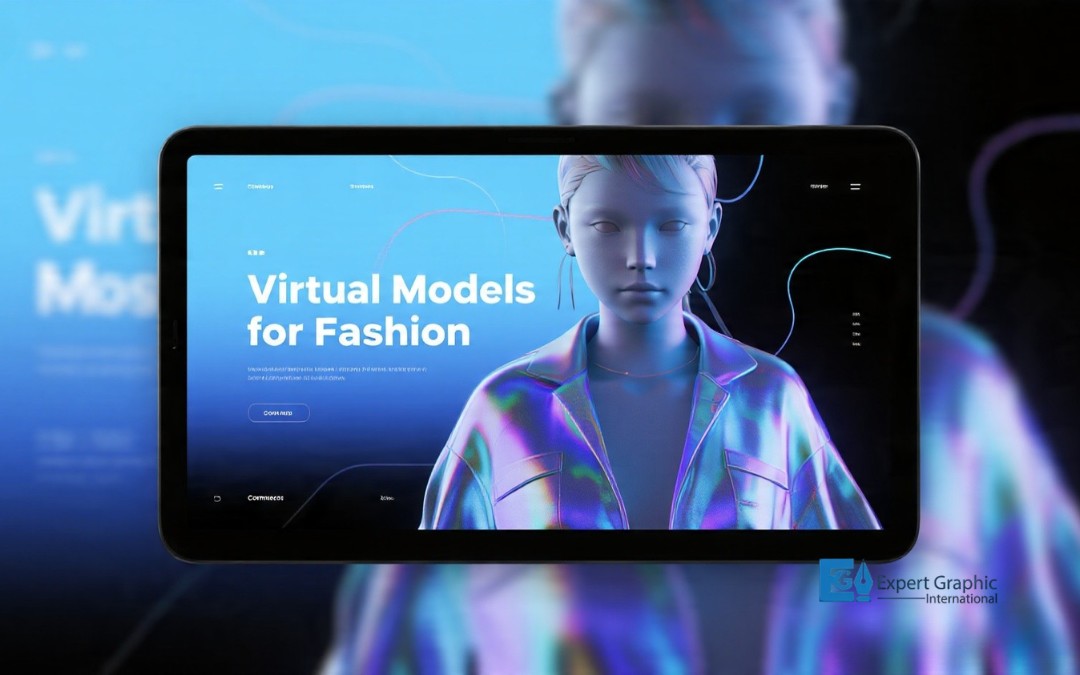
Virtual model AI generates photorealistic digital humans that wear clothing for online stores, replacing physical photoshoots. Brands use generative AI and 3D rendering to show one garment on multiple body types, skin tones, and poses in minutes instead of weeks.
What are virtual models?
A virtual model is a computer-generated human figure built to display clothing for fashion e-commerce, marketing, and social media. Designers create it with 3D modeling, machine learning, and generative AI instead of a camera and a live person.
Three types dominate the market right now. Fully AI-generated characters, like Shudu and Lil Miquela, exist only as code no real person stands behind the name. Calvin Klein and Prada have both booked these characters for campaigns, treating them the way a brand would treat any other influencer. Digital twins work on a different model: a real person signs a likeness agreement, and a studio scans their face and body once to build a reusable digital copy. H&M ran this exact pilot with 30 human models and kept explicit consent terms attached to every use. Then there’s the workhorse category CGI-built avatars made for product detail pages, where fit accuracy and repeatable lighting matter more than personality. Louis Vuitton’s decision to feature the virtual model Lightning in a 2025 campaign wasn’t a stunt; it signaled that even luxury houses now treat AI modeling as a normal production tool, not a gimmick.
How Do Virtual Models Work?
The short version: software reads the garment’s texture and shape from a photo, then maps it onto a digital body. The system analyzes a flat-lay, mannequin, or hanger shot, extracts the fabric pattern, and renders it onto a chosen pose and body type.
Two production paths get you there, and they trade off differently:
- Sculpting: Build the avatar by hand in CGI software like 3ds Max or Blender, creating a full digital skeleton and skin layer.
- Extraction: Pull the garment’s texture and pattern from the source photo using computer vision.
- Projection: Map that texture onto a generative AI model, adjusting for wrinkles, perspective, and body pose automatically.
- Lighting match: Set shadow, shine, and background to studio-quality standards.
- Rendering: Output the finished image or short video, often up to 4K resolution.
CGI wins on anatomical precision but needs a trained 3D artist and more hours per asset. Generative AI gives up a little of that control in exchange for speed and cost which is exactly why most fashion e-commerce teams have quietly switched to AI-based generation for their day-to-day catalog work, saving CGI for hero campaign shots.
How are they transforming fashion ecommerce?
Cost is the headline number, but it’s not the only one. Virtual models are cutting content production costs by up to 90% and shrinking photoshoot timelines from weeks to hours, according to brands that have already made the switch.
Zalando told the press that AI generated 70% of its 2024 editorial campaigns and cut production costs by as much as 90% against traditional shoots. Academy Sports, working with Stylitics’ AI Image Studio, produced 105,000 on-model images in a single year without growing its photoshoot budget at all. On the conversion side, DressX reports that shoppers who use virtual try-on convert to purchase at 10 times the rate of shoppers who don’t, measured on the same product page. Put those three numbers together and the pattern is hard to miss: lower cost, faster output, and better conversion are turning virtual models from a marketing experiment into standard e-commerce infrastructure.
What types of virtual models are used in ecommerce today?
Ecommerce brands currently use 5 types of virtual models: fully synthetic AI characters, digital twins, CGI-built avatars, text-to-model generators, and model-swap tools. Each one solves a different problem in the content pipeline, and most brands end up using more than one.
- Fully synthetic AI characters: Built with no real-world counterpart, used for long-term brand ambassador roles
- Digital twins: Real models license their likeness for reuse across unlimited virtual shoots
- CGI-built avatars: Commissioned for high-precision, repeatable catalog and PDP photography
- Text-to-model generators: Create a model from a prompt describing ethnicity, age, body type, and pose in one step
- Model-swap tools: Swap an existing model’s face or body on a photo while keeping the garment, pose, and background identical
A mid-size apparel brand might run all five at once: CGI avatars for the core catalog, a digital twin for wholesale line sheets, and quick text-to-model renders for testing new social ad creative before committing budget to it.
What are the benefits of virtual models for online retailers?
Virtual models cut photography costs by up to 90%, speed up production 10 to 20 times, and let retailers show every garment across diverse body types from a single upload. The savings come from removing studios, travel, and model-booking logistics from the workflow entirely.
- Lower costs: Cut photography costs by up to 90% one seller documented a drop from $1,500 to $15 per product image after switching
- Faster launches: Move 10 to 20 times faster, going from 3 to 4 weeks of traditional photography down to 1 to 2 days
- Broader representation: Show 3 or more body types, skin tones, and age groups from one garment upload, without booking separate models for each
- Catalog consistency: Keep lighting, angles, and model identity uniform across an entire catalog something real photoshoots struggle to match shoot to shoot
- Fewer returns: Help shoppers judge fit and drape before they check out, cutting size-related returns
- Unlimited reuse: Reuse one model identity across unlimited seasons and markets without a single reshoot
- Instant updates: Swap out-of-stock outfit pairings instantly instead of scheduling a new shoot around inventory
What are the limitations of virtual models for online retailers?
No technology is free of trade-offs, and this one has a few worth knowing before you commit a budget to it. Virtual models still struggle with fabric texture fidelity, emotional relatability, and growing ethical scrutiny over unrealistic beauty standards.
- Texture gaps: Render complex fabrics imperfectly sheer material, sequins, and heavy knits still trip up most generative models
- Relatability loss: Feel less relatable to shoppers who prefer seeing an actual person wear the garment
- Setup cost: Demand a real upfront investment in skilled 3D artists for fully custom CGI avatars
- Backlash risk: Draw public criticism over beauty-standard concerns, as Levi’s learned after its 2023 AI model campaign
- Platform gaps: Run inconsistently across ecommerce platforms, since not every storefront handles high-resolution AI renders the same way
- Disclosure rules: Carry new labeling obligations, as regulators and platforms increasingly require disclosure on AI-generated or digital-twin imagery
What tools and technologies power AI virtual models?
Under the hood, these platforms all lean on the same three building blocks: generative diffusion models, computer vision, and 3D rigging engines. The system reads a garment photo, isolates the fabric, and renders it onto a chosen digital human in seconds.
WearView and CamClo3D generate photorealistic models straight from a text prompt and support flat-lay-to-model conversion up to 4K. Photoroom bundles background removal with its Virtual Model feature and has built its user base largely among marketplace sellers on Etsy, Poshmark, and Depop. Genlook and Veesual go a different route, focusing on customer-facing try-on that lets a shopper upload their own photo and preview the garment before buying. Style.me and Browzwear lean B2B, using 3D garment scanning to chase down the fit-related returns that eat into apparel margins. Pic Copilot and Modelia round out the field with broad, Shopify-friendly toolkits aimed at smaller sellers who don’t need an enterprise contract to get started.
How can you create virtual models for ecommerce product photography?
You don’t need a studio, a photographer, or a booked model to get this done. You upload a garment photo, choose the model’s attributes, and generate an on-model render through an AI platform the whole process takes minutes, not weeks.
- Capture the garment: Photograph or scan it as a flat lay, ghost mannequin, or hanger shot
- Upload the image: Send it to a fashion model generator such as WearView, Camclo, or Photoroom
- Set attributes: Choose the model’s body type, skin tone, age, pose, and setting
- Generate the render: Check fabric texture, drape, and lighting for accuracy
- Adjust the output: Tweak the pose, background, or outfit pairing without reshooting the garment
- Publish the asset: Export the finished image or video to the product page, marketplace listing, or ad campaign
Brands running large catalogs tend to lock in a small set of reusable model identities first, then apply that same identity to every new garment so the storefront doesn’t end up looking like five different photoshoots stitched together.
How do virtual models compare to real models and traditional product photography?
Each method earns its place at a different point in the budget, and none of them fully replaces the others yet. Virtual models cost less and move faster than real models, while traditional photography still wins on texture authenticity and genuine human presence.
A single traditional shoot runs $1,000 to $1,500 or more per product and eats 3 to 4 weeks of planning, shooting, and editing. Virtual models bring that down to roughly $10 to $50 per image, with turnaround measured in hours. Digital-twin models sit in between: pay a licensing fee once, and reuse that real person’s likeness indefinitely across as many digital shoots as you need. Fully synthetic AI characters sit at the far end cheapest per image, easiest to scale, and also the most likely to draw shopper skepticism or trigger a disclosure requirement depending on where you sell.
How are brands using virtual models to improve ecommerce performance?
The brand list here is longer than most people expect, and it’s not just tech-forward startups. Levi’s partnered with Lalaland.ai to generate AI models representing a wider range of body types and skin tones, without booking a new photoshoot for every combination it wanted to show. H&M piloted digital twins built from 30 real human models and attached explicit AI disclaimers to every resulting image, a transparency move other retailers have since copied. Zalando shifted 70% of its 2024 editorial campaigns to AI-generated imagery, cutting production costs by up to 90% while keeping its publishing calendar on schedule. Academy Sports, through its Stylitics partnership, produced 105,000 on-model images in a single year without expanding its photography budget. Guess ran an AI-generated campaign in Vogue through agency Seraphinne Vallora, betting on speed and creative flexibility over a conventional shoot and drew real controversy for it. Victoria Beckham partnered with DressX to bring AI-powered try-on directly into its e-commerce site, chasing the same conversion lift DressX has documented elsewhere in the category.
How much do virtual models cost?
Virtual model tools run $10 to $99 a month for small catalogs, while full enterprise integrations land between $100 and $500 a month. Price scales with image volume, output resolution, and whether you need a fully custom avatar built for your brand.
- Entry-level plans: Cover under 50 images for $12.99 to $29 a month Photoroom and WearView Lite both sit in this range
- Mid-volume plans: Cover 100 to 500 images for $35 to $99 a month, like Modelia Basic or WearView Advanced
- Pay-as-you-go pricing: Platforms like Uwear charge around $0.10 per credit, which suits brands with seasonal or unpredictable volume
- Full platform integrations: Add a try-on widget to product pages for $100 to $500 a month
- Custom 3D renders: A one-off garment render from a visualization studio runs $50 to $600
- Enterprise digital-twin programs: Licensing deals like Browzwear’s brand-specific AI model program are quoted case by case
Weigh that against traditional photography, where sellers report paying around $1,500 per product for a physical shoot versus roughly $15 per image with AI generation. That gap is exactly why more finance teams now treat virtual models as a standard content-budget line item rather than an experimental one-off.
Start small: one garment, one platform, one product page. Once the fit and fabric texture hold up under your own quality bar, scale that same model identity across the rest of your catalog that’s the point where the cost and speed gains actually start compounding.
Can virtual models help reduce product returns in ecommerce?
Virtual models reduce product returns by showing shoppers accurate fit, drape, and sizing before checkout. StyleHub reported returns dropping from 28% to 18% after adding virtual try-on to its product pages, a 36% decrease in one quarter. Better fit visualization cuts the guesswork that drives size-related returns and bracket buying.
Are AI-generated virtual models accepted on major ecommerce marketplaces?
Yes, major marketplaces like Etsy, Amazon, and Shopify-based stores now accept AI-generated virtual model images for product listings. Platforms such as Photoroom and CamClo3D already serve sellers on Etsy, Poshmark, and Depop directly. Some marketplaces require disclosure labels marking AI-generated content, so brands check each platform’s specific imagery and labeling policy before publishing.
Do virtual model images still require photo editing or retouching?
Yes, virtual model images still require light editing for color grading, background matching, and final export formatting. AI renders arrive close to studio quality, but teams still fine-tune shadows, cropping, and file sizing before publishing to product pages. Retouching for AI images takes minutes per image, compared with hours for traditional photo editing.
How realistic are AI virtual models compared to traditional fashion photography?
AI virtual models now match traditional fashion photography in lighting and pose accuracy, though fine fabric texture on sheer materials, sequins, and heavy knits still lags. WearView and CamClo3D render up to 4K resolution, close to studio output. Most shoppers cannot tell an AI-generated model apart from a real photograph at standard product-page sizes.
What types of products work best with virtual models?
Virtual models work best with structured garments such as t-shirts, dresses, jackets, denim, and outerwear, where shape holds steady across poses. Flat, simple silhouettes render most accurately. Sheer fabrics, heavily sequined pieces, and complex draped garments remain harder to reproduce, since generative AI still struggles with fine texture and movement-based fabric physics.
What ethical and legal considerations should brands keep in mind when using virtual models?
Brands using virtual models face 3 core obligations: securing likeness consent for digital twins, disclosing AI-generated imagery where regulators require it, and avoiding beauty standards that misrepresent real body diversity. Levi’s and H&M both faced public scrutiny over these exact issues, prompting stricter consent and labeling policies across the industry.